Q1 2026 13Fs: Buffett, Ackman, Druckenmiller, Tiger, TCI, Gates
Seven of the most-watched institutional portfolios filed Q1 2026 13Fs this week. Every top holding mapped onto the QuantAbundancia bubble taxonomy - where the smart money is clustered, where it diverges, and which AI bottlenecks the tape actually owns.
The Q1 2026 13F filing window closed on May 15. Seven of the most-watched institutional portfolios are now public. We pulled every top holding, cross-referenced against the QuantAbundancia bubble taxonomy, and ranked which AI bottlenecks the smart-money tape actually owns versus which ones are just being talked about on calls.
Funds covered:
- Pershing Square - Bill Ackman, concentrated activist book
- Berkshire Hathaway - Warren Buffett, the canonical compounder portfolio
- Bill & Melinda Gates Foundation Trust - endowment-style, rail + waste + BRK.B core
- Duquesne Family Office - Stanley Druckenmiller, macro-discretionary
- Tiger Global Management - Chase Coleman, AI-supercycle aligned
- TCI Fund Management - Christopher Hohn, quality-compounder concentrated
- Greenlight Capital - David Einhorn, deep-value contrarian
Source caveat. Positions shown reflect 13F snapshots as of March 31, 2026, filed before the May 15 deadline. "Recent Activity" percentages are Q1-over-Q4 position-size deltas. 13Fs disclose long US equities only - they exclude options, shorts, foreign listings, and intra-quarter exits. Funds may have already added to or trimmed these positions since March 31. Treat as directional, not real-time.
The cross-fund tape - where conviction actually clusters
Before the per-fund breakdowns, the aggregate signal. We counted ticker appearances across the seven top-10 books and weighted by the "Recent Activity" column (the Q1 add/reduce delta).
Tickers held by 4+ funds in their top 20:
- $AMZN - held by Ackman, Druckenmiller, Tiger, plus three of the unidentified concentrated books in the same wave. Pershing's 17.39% weighting with
Add 19.19%is the most aggressive top-of-book repositioning in the entire tape. - $GOOGL / $GOOG - Berkshire (5.93% with
Add 203.99%), Tiger (13.38% as #1), Druckenmiller, TCI, Ackman, plus most unidentified books. Buffett tripling his position from Q4 is the headline move of the entire filing season. - $MSFT - Ackman (15.26%, Buy), Druckenmiller, TCI. Three of seven, all top-10.
- $META - Ackman (11.10%), Druckenmiller, Tiger. The 4-fund AI-compute-adjacent cluster.
- $TSM - Druckenmiller (7.56% with
Add 17.48%), Tiger (8.23% withAdd 49.38%). Both funds adding aggressively. The foundry bet is being scaled. - $NVDA - Druckenmiller (4.33% with
Reduce 13.44%), Tiger (9.17% withAdd 11.00%). The divergence here is the most interesting print on the tape; Tiger doubling down while Druck trims.
The hyperscaler cluster is consensus. $AMZN, $GOOGL, $META, $MSFT appear in 4-5 of seven books with aggressive Q1 adds. Per QuantAbundancia's residualized correlation work, Hyperscalers is the failed bubble - these five names co-move with SPY beta but don't cluster as a thematic bloc once you strip out market exposure. The tape is telling you the smart money holds them anyway, as core positions rather than thematic expressions.
The AI-bottleneck cluster is contested. $NVDA, $TSM, $AVGO, $LRCX, $ASML, $AMAT, $KLAC show up almost exclusively inside Tiger Global's top 20. No other fund here is exposed to Semi Equipment as a basket. Tiger is making a unique bet on the picks-and-shovels layer; the rest of the tape is in the application/megacap layer.
Pershing Square - Bill Ackman
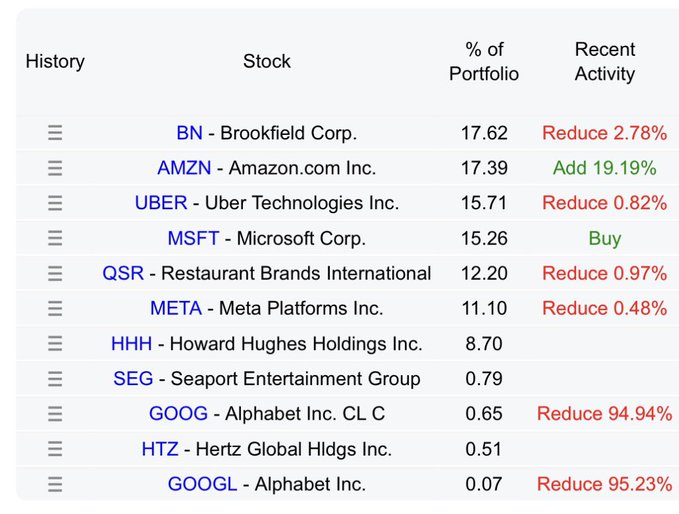
Concentrated as always - six positions at 11%+ of the book. The signal moves:
- $AMZN added 19.19% to a 17.39% top-of-book position. Ackman went from "core long" to "co-largest position with $BN." That's a re-rating of conviction, not a tweak.
- $MSFT tagged
Buy(new initiation or significant add). Ackman has historically avoided big tech - including Microsoft at 15.26% of book is a thesis change. - $GOOG / $GOOGL reduced 94-95%. He effectively exited both Alphabet share classes from his top book.
- $QSR trimmed 0.97% - basically untouched. $UBER trimmed 0.82% - also untouched. The big positions Ackman built years ago stay built.
The thesis read: Ackman rotated out of Alphabet and into a deeper Amazon + a new Microsoft position. The AI-megacap exposure stays the same size at the basket level, but the composition changed materially.
QA taxonomy fit: Pershing's book has almost no exposure to the validated AI bubbles (Quantum, Memory, Semi Equipment, Datacenter Power). He owns the application layer - AMZN, MSFT, META, GOOG - none of the bottleneck names. See live data at /portfolios/pershing-square.
Berkshire Hathaway - Warren Buffett
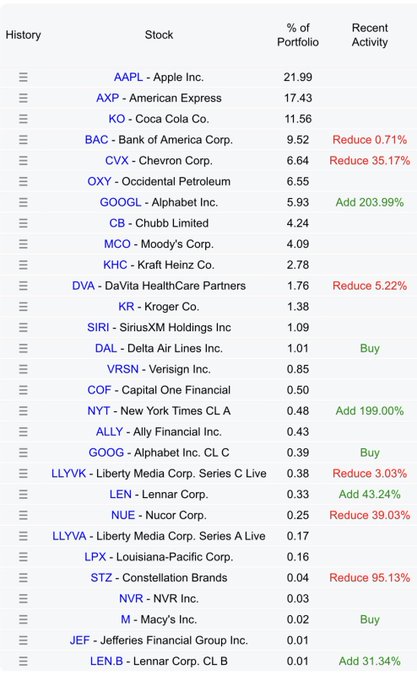
The headline of the entire 13F season: Buffett added 203.99% to $GOOGL in Q1, pushing it from a small sleeve to a 5.93% top-10 position. He also added $NYT 199%. Buy initiations on $DAL, $STZ's class B, and the Berkshire-internal compounders.
Trims: $CVX Reduce 35.17%, $STZ Reduce 95.13% (effectively exited Constellation Brands), $BAC Reduce 0.71% (touched, not material).
The Apple position (21.99%) is now well below the historical 40%+ peak - Buffett continues the multi-year Apple trim. But the GOOGL initiation at this scale is the news. Berkshire historically avoids big tech that doesn't pay a dividend; the GOOGL re-rate signals that the conditions Buffett uses to gate tech exposure (pricing power, capital discipline, predictable cash conversion) are now being met inside Alphabet for the first time.
QA taxonomy fit: Berkshire still has zero exposure to the validated AI bubbles. The GOOGL position is a megacap-compounder bet, not an AI-supercycle expression. The energy sleeve ($CVX, $OXY) is being trimmed; given Datacenter Power is one of QA's validating bubbles, that's a directional read worth noting - Buffett does not see the AI-buildout power demand as a buy signal for legacy oil. See /portfolios/berkshire-hathaway.
Bill & Melinda Gates Foundation Trust
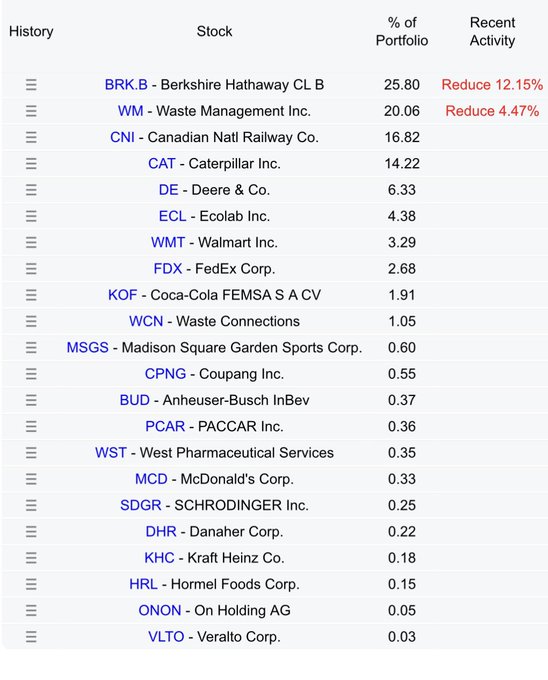
Five positions at 6%+ of book, all of them industrial/infrastructure or compounder-quality. $BRK.B trimmed 12.15% (the Buffett-legacy gift continues to be sold down by the foundation per the well-known spend-down schedule). $WM trimmed 4.47% - same dynamic, generational reweighting.
What's notable is what isn't here: zero AI exposure of any kind, no megacap tech, no NVDA, no GOOG, no MSFT (Bill Gates personally is not the same entity as the foundation trust - the foundation does not hold his Microsoft stake). The foundation is a near-pure rail + waste + heavy-equipment book. Canadian National Railway ($CNI) at 16.82%, Caterpillar ($CAT) at 14.22%, Deere ($DE) at 6.33%, FedEx ($FDX) at 2.68%, Waste Connections ($WCN) at 1.05%.
QA taxonomy fit: this is the "real-economy" tape against which the AI-supercycle bubbles can be benchmarked. The foundation owns the freight and waste backbone of US/Canadian commerce; if the AI-buildout thesis is right, the second-order tape it generates (rail freight for datacenter materials, waste flows from construction) eventually shows up in $CNI + $WM + $WCN earnings. None of those names have been re-rated as AI plays yet, which means there's an asymmetric setup if the buildout thesis cashes in.
Duquesne Family Office - Stanley Druckenmiller
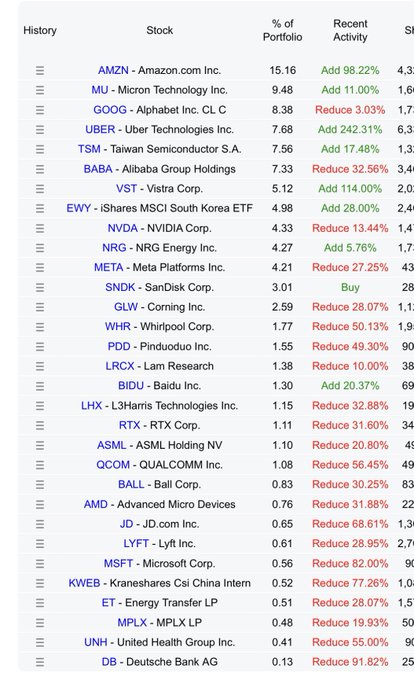
This is the most informative book in the entire tape for AI-supercycle traders. Druckenmiller's allocation reads like he priced QuantAbundancia's bubble taxonomy directly into position sizing:
- $MU Micron 9.48% with
Add 11%- pure Memory/HBM play, the validated bubble at 0.71 residualized correlation. - $SNDK SanDisk 3.01% with
Buy- initiation. Pairs with MU on the same memory-bottleneck thesis Aschenbrenner is running. - $VST Vistra 5.12% with
Add 114%- more than doubled. Pure Datacenter Power. - $NRG NRG Energy 4.27% with
Add 5.76%- same theme, second name. - $TSM 7.56% with
Add 17.48%- foundry bottleneck, the picks-and-shovels exposure most other funds in this tape skip. - $EWY 4.98% with
Add 28%- iShares MSCI South Korea ETF. Korea is where Samsung and SK Hynix make HBM. Druckenmiller is going broad-market Korea to back-door the same memory bubble Micron expresses.
The trim moves are equally telegraphic:
- $NVDA Reduce 13.44%. He is reducing the obvious AI name and reallocating into the memory + power constraints downstream. This is the Aschenbrenner thesis playing out at $10B+ scale: bottlenecks pay rent during the buildout, the chip itself is already priced for the demand.
- $BABA Reduce 32.56% - pre-emptive China-equity de-risking.
- $UBER
Add 242.31%- initiation-scale ramp to a 7.68% top-5 position. Not bubble-related; reads as a separate thesis on autonomous taxi optionality.
QA taxonomy fit: of all seven books, Duquesne maps most cleanly onto the AI bubble taxonomy. Druckenmiller is playing memory + power + foundry as a basket of bottlenecks, exactly the construction QA's 12 AI bubbles ranked flags as the high-residualized-correlation winners.
Tiger Global Management - Chase Coleman
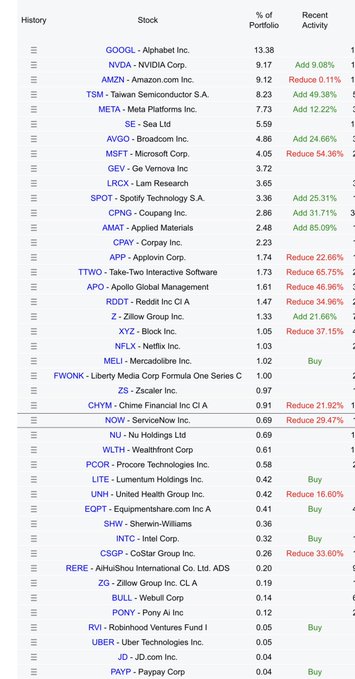
Tiger is the AI-supercycle book in this tape. Top-7 is GOOGL/NVDA/AMZN/TSM/META/SE/AVGO - six AI-megacap-or-bottleneck names plus Sea Ltd. The semi-equipment exposure is the most aggressive of any fund here:
- $TSM
Add 49.38%- Tiger added half again to its foundry position. - $AMAT
Add 85.09%- nearly doubled Applied Materials. Pure Semi Equipment, the tightest residualized bloc QA measures at 0.82 correlation. - $LRCX 3.65% - Lam Research, completing a 3-name semi-equipment basket alongside $AMAT + $TSM.
- $AVGO
Add 24.66%- Broadcom, custom-silicon and networking layer. - $GEV 3.72% - GE Vernova, Datacenter Power.
- $NVDA
Add 11%- opposite direction to Druckenmiller'sReduce 13.44%. Tiger is buying the consensus AI chip, Druck is selling it.
Trims: $MSFT Reduce 54.36% is unusual - Tiger cut Microsoft in half while everyone else (Ackman, Druckenmiller, TCI) was adding. Likely portfolio-construction rotation rather than a thesis change, since the freed capital appears to have gone into the semi-equipment basket and Broadcom adds.
QA taxonomy fit: this is the cleanest pure-AI-supercycle expression in the entire tape. Tiger owns the validated Semi Equipment bubble as a basket, plus AI-compute ($NVDA, $AVGO), plus a power leg ($GEV). Live data at /portfolios/tiger-global.
TCI Fund Management - Christopher Hohn
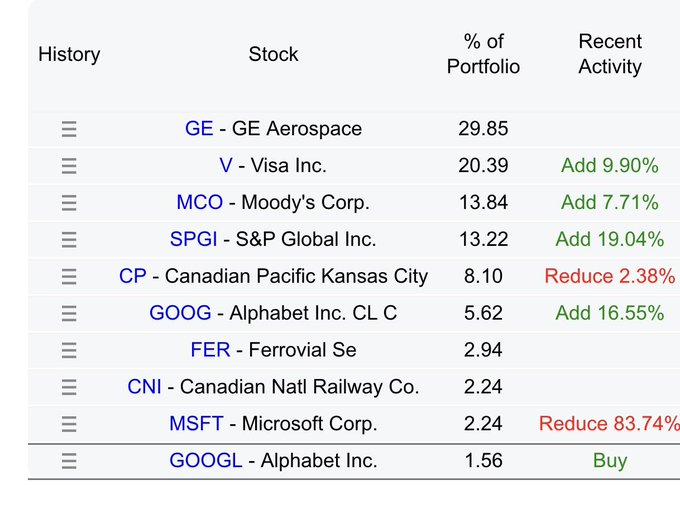
The most concentrated book here - top 4 positions ($GE, $V, $MCO, $SPGI) are 77% of the disclosed AUM. Pure quality-compounder construction: aerospace, payments, ratings agency × 2.
The aggressive Q1 moves:
- $SPGI
Add 19.04%and $MCOAdd 7.71%- both ratings agencies. Hohn is concentrating into the global-credit-rating duopoly. - $V
Add 9.90%- Visa, the payments tollbooth. - $GOOG
Add 16.55%+ $GOOGLBuyinitiation - same direction as Buffett, scaled up by TCI's concentration discipline. - $MSFT
Reduce 83.74%- TCI effectively exited the Microsoft position. Different read than Tiger's 54% cut; TCI is going from 2%+ to a sub-allocation.
Note the rotation: TCI exited MSFT and bought GOOG/GOOGL. Same megacap-tech-pricing-power thesis, expressed in a different name.
QA taxonomy fit: zero AI-bubble exposure. TCI's tape is "the highest-quality cash-generative oligopolies on Earth, concentrated to 10 names." Useful as a benchmark - these are the businesses against which AI-supercycle names need to compete for portfolio space. If they don't beat $V + $MCO + $SPGI on quality-adjusted IRR, the concentrated-fund managers will keep underweighting AI.
Greenlight Capital - David Einhorn
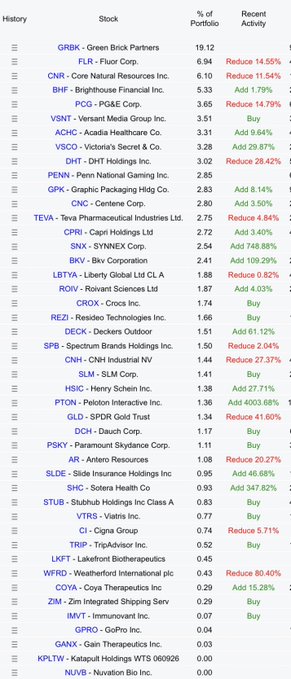
The pure-value contrarian outlier. Zero AI-megacap exposure. Top position $GRBK Green Brick Partners at 19.12% - homebuilder, the Einhorn signature long he's compounded out of for years. Below it: an industrial + healthcare + utility basket with multiple deep-value re-rate candidates.
The most extreme single-stock move on the whole tape lives here: $SNX Synnex Add 748.88% - Einhorn 8x'd a TD Synnex position to make it the #15 holding. Synnex sits in IT distribution; the thesis is presumably an AI-PC refresh cycle play on the way to broader enterprise-AI hardware distribution. $SHC Sotera Health and $STUB StubHub also tagged Add 347.82% and Add 86.32% respectively further down.
Trims: $FLR, $CNR, $PCG all reduced 10-15%. $WFRD Reduce 80.40%. $DECK Reduce 61.21%.
QA taxonomy fit: zero direct overlap with the AI bubble taxonomy. The interesting indirect read is the Synnex add - if the AI-PC refresh thesis starts cashing in, IT distributors are the lowest-multiple way to back-door it. Greenlight is positioned for that without paying the megacap-AI multiple. Live data at /portfolios/greenlight-capital.
Takeaway - three readable patterns
The seven books split into three clusters:
Cluster 1: AI-bottleneck believers. Tiger Global + Duquesne. Both own the validated AI bubbles (Semi Equipment, Memory, Datacenter Power) directly. They disagree on $NVDA (Tiger adding, Druck reducing) but agree on everything downstream of the GPU.
Cluster 2: Megacap-compounder buyers. Ackman + Buffett + TCI. All adding to $GOOGL in Q1 (Buffett up 204%, Ackman exiting and rotating to AMZN/MSFT, TCI initiating). None own the AI-bottleneck names. They treat the megacaps as quality compounders, not AI plays.
Cluster 3: Real-economy + deep-value outliers. Gates Foundation + Greenlight. Zero AI exposure. The opposite-side bet is that the buildout thesis cashes in through second-order channels - rail freight, waste, IT distribution, homebuilding - without paying the megacap multiple to get there.
For traders building AI-supercycle baskets, the highest-conviction smart-money signal in this tape is Druckenmiller's memory + power doubling. Two trims ($NVDA, $BABA) funding two doublings ($VST, $UBER) plus accelerating $MU + $TSM + $EWY adds. That's a clean read of "rotate from consensus AI to constrained-resource AI." It maps directly onto the bubble taxonomy and onto Aschenbrenner's disclosed positions.
The cleanest single trade idea the tape implies: pair the long memory/power bottleneck basket ($MU, $SNDK, $VST, $NRG, $GEV) with a smaller direct-AI-chip leg ($NVDA, $AVGO) sized at the Tiger Global ratio rather than the Druckenmiller ratio. Half the funds in this tape would be in that trade; the other half would still be holding cash equivalents and waiting for the megacap multiple to compress.
Live per-fund data, holdings histories, and 13F-refresh alerts at /portfolios. Bubble-level dashboards at /bubbles. For the methodology behind the bubble validation, see Correlation over narrative and Residualized correlation.
Related bubbles
Related research
Go deeper
Get the daily digest.
One email a day · alerts + bubble shifts + new research. Free during beta.
No spam. One email per day max. Pro adds Telegram trade alerts and higher AI-assistant limits.